The Vital Role of Social Media Marketing Service Providers

See the source image

There are many advantages to hiring a social media marketing agency over doing it yourself.

  • Data-driven marketing strategy
  • Brand Visibility Boost
  • Maximum Lead Generation
  • Retaining Customers
  • Understanding Social Media Users
  • Branding and Image Building
  • Analyzing and Adapting

1. Data-driven marketing strategy

Never jump into social media without a plan. You’re doing it wrong if you’re randomly posting content on social media with only short-term goals in mind. Social media marketing service providers create a comprehensive marketing strategy based on results.

This includes finding out what your audience wants and creating it. Data will also dictate when to post and what type of content works best.

2. Brand Visibility Boost

Brand visibility is a key outcome of a company’s social media activity. When properly promoted, your page can be a huge success in promoting your brand.

Nothing matters more than a great logo and a great service. Only a well-represented brand on all social media platforms gains recognition. You need a consistent voice and message. Your brand needs a personality that evolves with the times.

3. Maximum Lead Generation

The expertise of a lead generation firm using analytics to target the right audience will be useful. Experts can convert likes and subscribers into actual money-spending customers on your website.

There are so many different consumer bases and target audiences on social media that going in blind is foolish. A SMM service finds relevant leads for you.

4. Retaining Customers

Engagement is key to success. A marketing agency can manage all of your social media accounts. They’ll engage your customers, address their concerns, and establish your brand as one that listens.

This can give you a huge competitive advantage.

5. Understanding Social Media Users

Your target demographics vary by social media platform. In terms of demographics, Facebook is the most popular, followed by Instagram and Reddit.

Depending on your industry, some social media platforms may be better than others. If your target demographic is teenagers and young adults, you should focus on platforms like Snapchat and Instagram where they are most active. For a plumbing brand, relying solely on Instagram may not be wise.

The end goal is to make a sale to whomever you target. That’s why you should leave social media marketing to the pros.

For your e-commerce site or business page, a professional marketing service will know what to do and where.

6. Branding and Image Building

Businesses often struggle to define and articulate their brand vision in so many words. The idea is there, but it needs polishing. A social media marketing service can help you develop your brand’s identity and get to the heart of what you offer customers.

A strong brand identity is critical to connecting with your target market. Again, this goes beyond a logo or a few catchy posts. You need help developing your brand’s personality, tone, and outlook. A viable strategy requires competitive research and brand differentiation.

Social media marketing already sounds complicated, which is why a team of marketing experts is required.

7. Analyzing and Adapting

After presenting and implementing a social media marketing strategy, it is critical to monitor the results. A marketing team monitors the effectiveness of strategies and makes adjustments as needed. The team can analyze and adapt to improve.

SEO and social media marketing services can make or break a business. You need both of these services to make your brand stand out in the crowded online market.


What You Should Know About PPC Management

See the source image

Pay per Click (PPC) advertising is a type of online advertising in which advertisers are compensated each time a user clicks on their online advertisements. PPC is one of the most effective methods of increasing website traffic, and when done correctly, it can help you stand out from the competition.

Contents

  • Definition of PPC Management
  • Main objectives of PPC
  • PPC Manager Tasks

Definition of PPC Management

It is the process of monitoring and managing a campaign’s PPC advertising expenditure.

These companies can either manage their own PPC campaigns or hire a third-party agency that specializes in media buys and/or PPC management.

It’s critical to execute PPC correctly if it’s part of your digital marketing strategy. So PPC Management takes time and digital skills. Paying for PPC management services allows you to focus on other aspects of your business. These are the skills you need to learn if you want to manage your own digital advertising budget.

Main objectives of PPC

These are the three main goals you should aim for when working with a PPC model.

1. Reduce ad budget and spend waste

Wasted ad spend is a major issue in marketing. Qualitative over quantitative digital advertising waste prevention This is one of the most important tasks for PPC managers.

2. Lower your average cost per click (CPC)

By improving your ROAS, you will automatically lower your CPC. The cost per click is the fee an advertiser must pay for each user click. Low CPC means more leads for your ad budget and lower cost per acquisition.

3. Boost your Return on advertising spend (ROAS)

Return on advertising spend (ROAS) measures how much revenue your company earns for every dollar spent on advertising.

PPC Manager Tasks

Some of the PPC Manager Tasks are as follows:

  • Competitive Analysis

In digital marketing, you can use your competitors as a source of inspiration for both good and bad. PPC managers must also constantly monitor their competitors’ actions, weaknesses, and strengths. It’s not about being like them, but about being better by being different.

  • Monitoring

A pay-per-click campaign is monitored to assess and improve its performance. Only tracking and monitoring results will ensure that your PPC budget is driving business growth.

CTR is one of the most closely watched metrics by PPC managers. Divide the clicks by the impressions to get your CTR. It shows that your target audience found your ads interesting and useful.

  • Keyword Analysis

It’s the process of learning how your target customer searches for your products or services online. Keyword research is the foundation of any successful PPC campaign. PPC managers should always start by organizing keyword lists and bidding on relevant keywords.

  • Channel Plan

Digital marketing channels are the various platforms you can use to inform your target audience about your brand, product, or service. Each channel can help with specific business goals. Some are suited to specific ages or interests. Knowing which channels to use is critical to a PPC manager’s job and to your PPC strategy.

Email, websites, organic search (SEO), paid search (SEM), mobile, and display are all digital marketing channels.

  • A/B Testing

AB testing is used to improve ad performance. Test different text ad formats to see which works best with your target audience. You can change the title, ad copy, or call to action in each ad (CTA).

Content Marketing Quotes That Will Help You Become a More Effective Marketer

See the source image

Content Marketing Quotes

  • “The most effective marketing is marketing that doesn’t feel like marketing.” Tom Fishburne
  • “What benefits people also benefits business.” – Leo Burnett
  • “Content marketing is a lot like going on a first date. If all you do is talk about yourself, there will not be a second date.” David Beebe
  • “Broadcasting the same message across multiple channels is the quickest and most effective way to turn off your community members. Instead, identify the types of content that will be of interest to your community’s members and present it in a way that will be useful to them.” Joe Pulizzi
  • “Great marketers have a tremendous amount of empathy for their target audience. They can put themselves in their shoes, live their lives, feel what they feel, go where they go, and respond in the same way that they would respond themselves. Content that resonates with your audience reflects your empathy for the people reading it.”- Rand Fishkin
  • “There is no content strategy without a measurement strategy,” says the author. It’s vital to understand your goals before embarking on a content initiative, regardless of the medium or platform.” Rebecca Lieb
  • “Content curation is a logical and essential extension of the content creation process. That is, no matter how good your content is, your audience is looking to learn from other experts and different points of view” Pawan Deshpande
  • “More content does not equate to better content. If we take our time and conduct some research, what is the worst-case scenario? Kristina Halvorson
  • We must stop interfering with what people are interested in and instead become what people are interested in.”- Craig Davis

More Quotes on Content Marketing

  • “It is not always the most compelling content that wins. It is the most effectively promoted content that wins.” – Andy Crestodina
  • “When we create something, we ask ourselves, ‘Will our customers appreciate what we’ve done?’ I believe it is critical for all of us to consider whether or not the marketing we are creating is truly beneficial to our customers. Will they express gratitude to us for it? “I believe that if you look at things through that lens, it simply clarifies what you’re doing in such a straightforward and elegant manner.”- Ann Handley
  • “I believe that marketers are extremely message-focused. They are well aware of what they want people to hear. They will have to work backwards from there in order to figure out how to make that a possibility. What they should do is look for something that is different or interesting that will attract the attention of others. Concentrate on figuring out what that thing is; don’t be concerned about the message for the time being. Simply identify the most interesting part of the message and then figure out how to connect it to the rest of the message.”- Andy Weir
  • “The goal of a content-first approach is not to produce more content; rather, it’s to produce the smallest amount of content that produces the greatest number of results”- Robert Rose
  • “Putting out content that you want to publish is very different from putting together an effective content marketing program that connects with customers by delivering meaningful experiences that are contextually relevant.” Ardath Albee

How to Measure the Effectiveness of Your Marketing Efforts

See the source image

We do spend marketing dollars on trade shows, advertising, conferences, events, webinars, and campaign materials.

How do we know what we get back? How can we measure marketing results to ensure they are worthwhile?

Contents

  1. Setting of Goals
  • Budget for Campaign
  • Quantitative and Qualitative Goals
  • Fulfilment and Response Strategy
  • Campaign Tracking and Testing Criteria
  • Follow-up Plan
  1. Cost Calculation

See the source image

1. Setting of Goals

This may seem like a simple question, but it is frequently asked. We’ve seen companies who don’t track their marketing. That’s a big mistake. While marketing is often a game of trial and error, you can reduce errors by using calculations to determine which campaigns deliver the best value for money.

Without a consistent plan and marketing strategy, you are simply marketing blindly. This is a costly business blunder.

Each marketing campaign must have a plan and strategy that includes:

  • Budget for Campaign

How much will you spend to achieve your qualitative and quantitative objectives? What is your desired budget outcome? What defines a successful spend?

  • Quantitative and Qualitative Goals

Qualitative goals are distinct from quantitative goals because they focus on benefits rather than numbers. Describe how customers perceive your product or service. The position of your product or service in relation to your competitors is also qualitative. You improve your product’s position by educating others on its quality. Also, target a specific niche or market and present your specialty as an expertise. Qualitative data require awareness as well. You must promote what you have to offer. This is vital to getting the consumer to buy from you. Advertising can often raise awareness. Quantitative marketing is about the numbers. How many units were sold, how many attendees, or how many leads were captured.

  • Fulfilment and Response Strategy

How will you fulfil orders, provide services, and respond to customers based on your marketing strategy?

  • Campaign Tracking and Testing Criteria

Most goals can be effectively measured using one of three methods. These include cost per sale, qualified lead, and visitor.

  • Follow-up Plan

How do you follow up? Will you use drip marketing or lead nurturing to stay in touch with customers who don’t buy right away? How will you follow up if they don’t buy?

2. Cost Calculation

Calculating is simple once you’ve decided which outcome to measure and the associated costs.

Using the appropriate formulas, along with a campaign plan, will help you determine the success of a campaign or event. If it was, congrats! If not, go back to the campaign’s efforts and figure out why it didn’t work and how to improve it next time. Is it the venue or the marketing? Maybe your materials didn’t have a strong call to action?

Marketing campaigns can fail for many reasons, but determining the reasons will help you succeed in the future.

How does Call Tracking Works?

How Does Call Tracking Technology Work? » Tell Me How - A Place for  Technology Geekier

Conversions from viewers who chose to call were difficult to track in the early days of digital advertising.

Because of this, campaign data did not always tell the whole story. However, with call tracking, you can now enable advertisers to link calls to specific ads.

It’s even better now that phone tracking has evolved to include more features and capabilities.

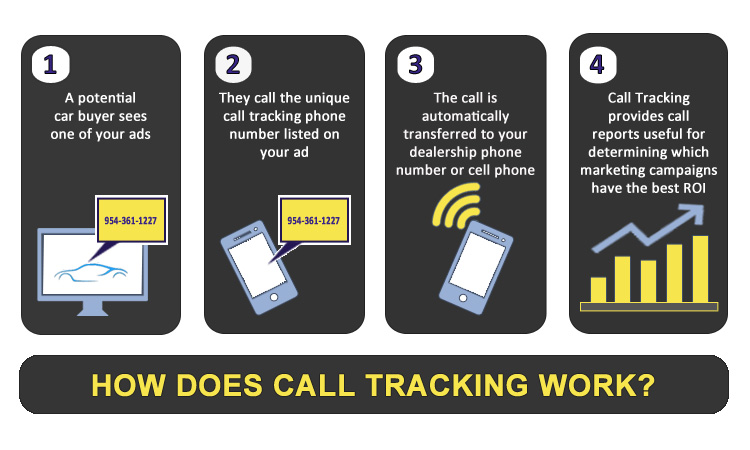
That leaves us to wonder how call tracking works. So, here’s how it works:

Contents

  • How Call Tracking Works
  • What are the benefits associated with call tracking?
  • Call tracking flexibility and options

CarCasm | Car Dealership Website Services

How Call Tracking Works

Call tracking works by associating a local or 800 number with a business phone line. When the ‘new’ number is called, the call is forwarded to the business line. The assigned number is associated with technology that enables the following tracking:

  • Caller id
  • Recording of calls
  • Source of Call (traditional/digital ad, PPC/SEO)
  • Date, time, and duration of call

What are the benefits of call tracking?

So why should you track calls in your next campaign?

  • Easy to apply
  • Caller data can track actual sales/enrollments.
  • Statistically significant campaign optimization using channel and keyword data.
  • Measuring media spend ROI accurately costs money.
  • A large percentage of conversions come from phone calls.
  • Callers are highly motivated bottom-funnel individuals

Call tracking flexibility and options

Depending on your industry, call tracking offers a variety of options.

  • Single source dynamic tracking
  • Call whisper
  • Call recording & greeting
  • Conversion settings

1. Single source dynamic tracking

You can track any or all sources with single source dynamic tracking.

Consider a recent Google AdWords campaign that you want to properly attribute ROI to.

One of your AdWords campaigns must be active to generate a call tracking number.

Your regular business phone number appears if a user clicks on an organic listing or comes in through direct or referral traffic.

For example, some businesses want to track calls from all digital sources, while others only want to track paid calls from digital sources. Every situation is flexible with dynamic tracking.

2. Call whisper

Prior to connecting, the caller hears ringing and a short message called a whisper message.

Call whisper provides real-time feedback by telling you which marketing campaign your call is from.

Incoming call from our Google AdWords campaign, for example. So, before the call even starts, your staff will know exactly what the user wants to discuss.

3. Call recording & greeting

To keep track of customer service and employee performance, call recording may be used to record calls.

Any time before the call is connected (e.g. to inform them the call will be recorded), or at any time in your call flow, you can upload, type, or record a custom greeting to play to the caller.

4. Conversion settings

This option lets you specify which actions you can report as conversions.

Calls lasting a minute or more can be converted, for example. This allows you to specify when a second call is not considered a conversion.

Customize conversion settings to fit your business.

What is the Importance of Email Campaign Reporting?

See the source image

Email campaign reporting is tedious but necessary for email marketing success. Here’s why it matters and how to do it right.

Measuring results improves results

The goal of any digital marketing strategy is to improve results using data. To improve your email campaign results, you must analyze and act.

Some key email metrics to track include:

Bounce Rate: The percentage of undeliverable emails. To keep a high-quality subscriber list, monitor your bounce rate.

Click-Through Rate: Percentage of email recipients who opened your email. Sending readers to a landing page can result in downloads, purchases, or demo requests.

Open Rate: This is the percentage of people who opened an email campaign. The subject line and the topic are the main factors affecting open rates.

Marketers can better understand their target demographics by tracking these metrics. Only with this knowledge can we make changes to improve results.

Use A/B testing to determine what topics resonates with the target audience if open rates are low. Try different calls to action or make them more prominent within the email to increase click-through rates.

Analyzing, improving, refining

It’s your job as an email marketer to analyze campaigns and make data-driven improvements. Keep these suggestions in mind when creating campaign reports.

Make reports well-organized and navigable. Reports should be well-organized for easy access to campaign data.

Use detailed data. Campaign reports should include all key metrics to provide a clear, complete, and timely picture.

Addition of insights to reports. You should be able to add recommendations to the report based on data insights. This helps stakeholders see the big picture without having to analyze all the data themselves.

Find a tool that generates reports automatically to match this cycle. This ensures campaign data reaches the right stakeholders at the right time.

Generation of report automatically. An email campaign typically has a three-day lifecycle. Then comes data collection.

Ease distribution. Multiple stakeholders require campaign results (salespeople, marketing executives, clients, etc). Find a tool that lets you automatically distribute reports as PDFs or web pages.

Tools that get the job done

Most email service providers manage campaigns and collect data well. While this data is valuable, creating and sharing reports with other stakeholders can be difficult.

But tools like CM Reports easily solve this. CM Reports from Core Online Marketing helps agencies and marketing teams automatically generate and distribute detailed reports with insights and recommendations.

This tool saves email marketers time and ensures that all stakeholders have access to campaign performance data.

In Conclusion

Without reporting on your email campaigns, success will be hard to come by. Although tedious for time-crunched marketers, the value is well worth it.

Your email program will succeed if you know what to measure, build clear reports, and use the right tools.

8 Best Free Email Marketing Tools

See the source image

When sending out important email promotions, it’s easy to overlook email marketing tools. Those who do email marketing frequently use autoresponders, which serve no purpose. In fact, every business needs email marketing tools to succeed.

It is the act of sending an expert message to potential customers to encourage the purchase of services and products.

According to statistics, more than 75% of B2C marketers and 85% of B2B marketers are already using email as a content marketing channel.

Just as important as your ISP and web hosting are your email marketing tools. To be clear, the tools you choose should not only help you build meaningful relationships with prospects, but also increase the impact of these interactions

1. HubSpot Email Marketing

The Hubspot email marketing tool is a great way to ignite your marketing funnel. This platform will help you scale and grow your business effectively. This free marketing tool also has other features that will help you improve your email marketing.

Hubspot’s CRM and marketing automation platform will give you detailed information about how your efforts are affecting your audience. You will also get a customizable landing page builder and sign up forms to collect leads. Hubspot is a good choice because it is free.

2. Mailchimp

Mailchimp is a popular email marketing service. This platform has A/B testing, email newsletter templates, and an integrated CRM. Mailchimp is a creative assistant that resizes designs to fit your business.

If you rely solely on visuals, the platform gives you access to its content studio, where you can store graphics and images. Its behavioral tagging also allows you to target marketing campaigns. Overall, Mailchimp is the best emailing tool available for free.

3. EmailLite

MailerLite is a free email marketing tool with a simple user interface and drag and drop editor. The best part is the built-in photo editing feature that can be used to create newsletter pictures that represent your business.

A/B testing tools and advanced segmentation are also included in its free feature. Whether you are a beginner or an expert, MailerLite will help you grow and send your first email campaign in no time.

4. SendPulse

Free tools for multi-channeling are plentiful, but choosing the right one can make all the difference. SendPulse is a top-notch email marketing tool. It has options for transactional emails and SMS marketing. This platform’s unique features allow users to create marketing campaigns using responsive templates and automated emails.

This platform provides a free Web Push service, as well as free messaging on Facebook Messenger. This platform’s email marketing is sophisticated and includes a drag n drop editor.

5. Moosend

Moosend is the best email marketing tool for creating and automating campaigns. Moosend’s drag and drop email builder, with various email newsletter templates, will make you a pro even if you lack technical expertise. It will also provide you with the best segmentation and automation workflows to increase your conversions.

Improve your email list and deliver great personalized content to your fans. This email marketing platform is suitable for new businesses that want to email at least 1k subscribers per month.

6. MailJet

The best transactional email service is MailJet. APIs, advanced email marketing tools, and Webhooks are available. Although it provides a free email marketing service, you can upgrade to a paid plan if you want more for your brand.

Also, MailJet’s segmentation feature and drag n drop email builder will help you create personalized email campaigns. It also allows you to upgrade multiple things at once. The free email marketing tool has no support.

7. TinyLetter

TinyLetter is a free email marketing tool that allows you to sign up with up to 5k contacts. You will also be able to create attractive forms for users to sign up for your newsletter. It has a simple email editor where you can format, add text, and send. Tiny Letter is a simple solution for those who don’t want anything heavy.

8. CleverReach

CleverReach, one of the best free email marketing tools available today, has quickly gained a large following. In addition to being a technology service provider, it is very smart. It claims to be the most popular free email tool and gets high marks for its user-friendliness.

But there is always room for improvement. With CleverReach Plugins, you can easily connect your CRM or CMS. You can also benefit from its reminder emails.

How To Increase The Conversion Rate Of Your Ecommerce Site

See the source image

What good is keeping track of conversion rates? Why should we improve eCommerce conversion rate? How to boost eCommerce conversion rate? Then you’ve come to the right place.

Why is it important to improve eCommerce conversion rates?

A good eCommerce conversion rate and social proof eCommerce site are the main goals of having an online store on your website and social media. However, according to 2016 Econsultancy and RedEye CRO reports, only 22% of businesses are happy with their conversion rates, and 35% have a rate less than 1%.

Conversion rate optimization (CRO) is the most neglected aspect of digital marketing. This is why every eCommerce manager must test multiple methods to increase eCommerce conversion rates. Not to brag, but Rein Digital can help you increase your eCommerce conversion rates.

If you are determined to improve your company’s rates, keep in mind the following points.

1. Improve product descriptions

In an eCommerce website, product descriptions are important because they not only describe the product but also improve the user experience and the online store. It will help customers decide.

So, make the description simple to read, concise, and engaging for the site visitors who should use the product.

2. You should focus on Product Pages and Images

Images are one of the many conversion optimization secrets. The main difference between shopping online and shopping offline is that customers can touch the product before buying it. To avoid this and keep in touch with potential customers, uploading high-quality product images to the product page is essential.

So, the more customers swoon over product images, the more potential customers will add to the cart during checkout. The first step is to upload high-quality images with no white space and as many angles as possible. All of these tips will help you convert more visitors into buyers and thus increase your eCommerce conversion rate.

3. You can leverage on Personalization

Personalization is the key to increasing eCommerce conversion rates. Forrester Research found that 66 percent of consumers said personalized content influences their buying decision, and they can’t help but add to the cart. This enables people to buy their desired products more quickly and efficiently.

Personalization can revolutionize online stores by improving the user experience. It has AI-powered tools that help optimize eCommerce. Also, keep up with the latest digital marketing trends.

4. Reduce or eliminate shipping costs

Around 50% of eCommerce merchants offer free shipping to their customers, with some offering fixed rates and others adding the cost if it exceeds a threshold.

A study found that people who shop at eCommerce sites that offer free shipping are more likely to feel rushed. If your company does not allow free shipping, make sure your customers can see or track their packages, or set a flat rate for shipping on your social media platforms.

Mobile App Vs Mobile Website: Which is Best for Your Organization?

Humans have come a long way in terms of behavior and interaction with web platforms in our current world. In the beginning, we collectively denied using online means for activities such as shopping, but with time, many people realized its benefits. Similarly, while initially the masses preferred big screens; there has been a noticeable shift in human tendencies to get things done faster on their handheld devices- mobile phones.

Despite this, many of us prefer to perform certain tasks on our laptops or desktops rather than our smartphones. Despite the transition and confusion, it is clear that users prefer mobile devices to laptops or desktops. But, most organizations are still stuck on whether to invest in a quality mobile website or a mobile app.

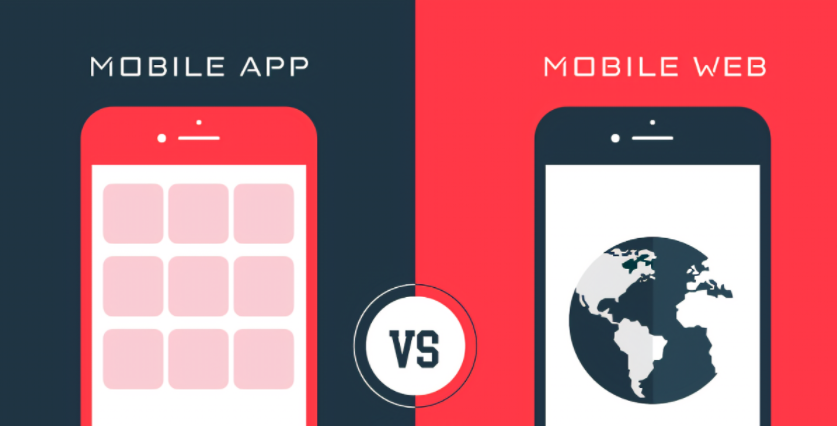
App vs mobile website has been a long-standing debate. In today’s blog post, we will try to decode this very confusion for you.

Mobile App Vs Mobile Website: What’s the difference?

  • Mobile Website: A mobile website is a desktop website that has been optimized and scaled for mobile viewing. A mobile website has less white space, less page elements, and less fonts and logos than a desktop website.
  • Mobile App: A mobile app is a different story. A mobile app is a program that is accessed by the user via the internet, but its programming is different from a mobile website. Users benefit from faster, cleaner, more interactive and intuitive user interfaces.

Which do users prefer?

Researchers and data analysis have determined that users spend up to 90% of their time on mobile apps rather than browsers. Apps provide an unparalleled user experience in terms of speed, features, and functionality.

In terms of millennial usage, it is rare to find a millennial or Gen Z kid who prefers mobile websites to apps. This is especially true for e-commerce and retail mobile apps. Due to their excessive use of Facebook and similar platforms, parents and baby boomers are responsible for major revenue streams!

Mobile apps are also preferred due to the user engagement they provide. However, once users are aware, they will go to the stores to download the app rather than spend more time on the websites.

A Comparison of Mobile App Vs Mobile Website

According to a Criteo study, “mobile apps push more people down the purchase funnel, with 3x higher conversion rates than mobile sites and even 1.5 times more conversions per session than desktop.”

One reason is that mobile websites do not save user data. Your phone may ‘remember’ your credentials, but most mobile websites do not. As a result, most carts are abandoned during checkout due to user annoyance. Mobile apps, on the other hand, solve this issue by saving your credentials once entered, saving you time at checkout.

8 Easy Ways to Improve Your Domain Authority

See the source image

Proper understanding of your domain authority aids in marketing planning. It is the number of relevant backlinks from other reputable websites that contribute to the scores. It also assists businesses in determining their SERP (search engine results page) rank by combining the root domains and the total number of links into a single DA score that compares the websites for ‘ranking strength’ over time.

Nevertheless, some brands are naturally authoritative due to the keywords that naturally carry some weight. For example, IMDB has a high domain authority that is naturally integrated with related keywords.

This gives you ideas to improve your site.

How to boost domain authority in 8 steps:

  1. A relevant domain name
  2. Creation of quality content
  3. Optimization
  4. Responsive websites
  5. Make use of internal link structures
  6. Eliminating toxic and flawed links
  7. Increasing the loading speed
  8. Social media promotion


1. Have a relevant domain name

Starting a website requires a strong and relevant domain name. The name should be easily remembered by visitors, increasing the likelihood of them returning to the site and not forgetting it while browsing the web. If you already own a domain name and don’t want to create a new one, buy it from them. Also, keep renewing it to avoid deactivation.

2. Creation of quality content

Regularly publish high-quality content to earn links from multiple domains. Creating better content will attract other authoritative sites to link to your brand, making it more relevant to the audience.

3. Optimization

Optimization affects both Google ranking and domain authority. So, remember to optimize the page by adding tags like title, image alt, and content. Include a few variations for the main keywords in the permalinks, and create a sidebar section for new posts.

Create long-form, in-depth content that covers a wide range of topics to keep the keywords and content relevant. This helps Google understand your blog post’s context. For example, if the post is about the fruit or the iPhone conglomerate.

4. Responsive websites

It is true that a large portion of the audience accesses websites via mobile phones. So, if your website isn’t mobile-friendly, you’re behind. They also impact mobile search engine rankings, resulting in a smaller audience. So, update the website soon and make it mobile friendly.

5. Make use of Internal link structures

Less time is spent searching for internal links, which improves the user experience. Visitors can easily navigate back to the homepage if they get lost in the blog’s archives. This keeps visitors engaged and prevents them from leaving the site, making it easier for search engines to index the entire site.

6. Eliminating toxic and flawed links

You must visit the profile yearly and look for faulty backlinks. This process/habit will help remove bad links that could harm the domain authority.

Also, remove broken links from your website to avoid a negative impact on your audience.

7. Increasing the loading speed

Because many users lack patience, they may leave the website, causing a negative effect and increasing the bounce rate. Check the website’s loading speed using a Google developer’s page speed tool, which will also help improve the user experience.

8. Social media promotion

Social signals are important ranking factors. Encourage your followers to like, share, and comment on your content. You could also add social media buttons to the pages.